
[ad_1]
Because the job market cools and CEOs pull back on hiring, it is no shock that the Federal Open Market Committee cut rates by half a share level on Wednesday, bringing it down from a 23-year high to a spread of 4.75% to five%.
Economists predicted the extremely anticipated determination, with EY senior economist Lydia Boussour telling Entrepreneur final month that there could be three fee cuts, every of at the least 0.25%, in September, November, and December.
Federal Reserve Chair Jerome Powell explained the September decision in a press convention on Wednesday, stating that the Fed is “guided by our twin mandate to advertise most employment and secure costs for the American individuals… As inflation has declined and the labor market has cooled, the upside dangers to inflation have diminished, and the draw back dangers to employment have elevated.”
In separate statements despatched to Entrepreneur, EY and J.P. Morgan consultants agreed that the Fed acted with “agility.” They’d completely different factors of view about whether or not the Fed was falling behind the curve.
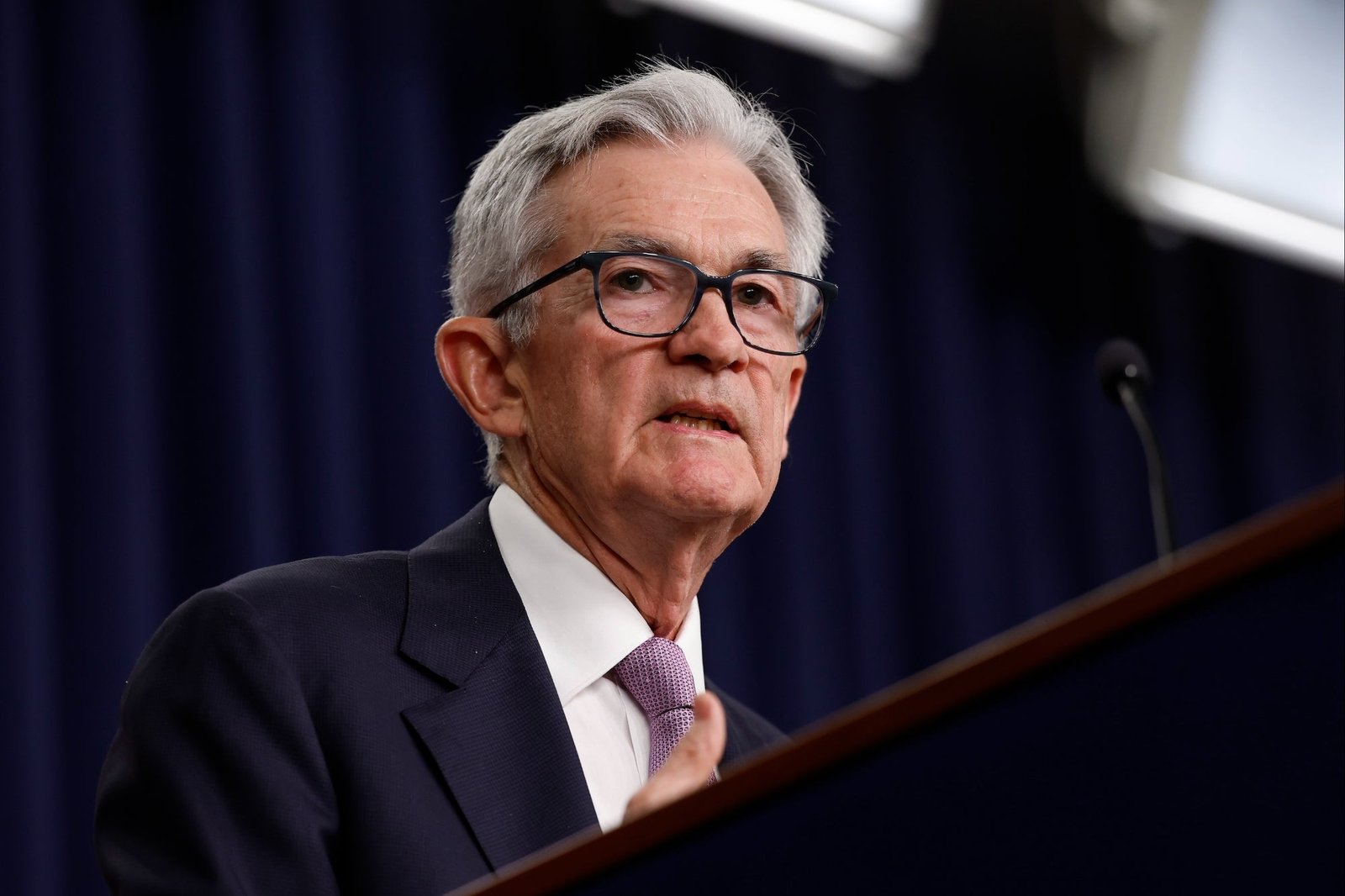
Federal Reserve Chair Powell. Credit score: Anna Moneymaker/Getty Photographs
Elyse Ausenbaugh, Head of Funding Technique at J.P. Morgan Wealth Management, said that the Fed delivered its determination with “confidence and dedication.” A 0.5% lower “preserves the Fed’s agility to take care of the data-dependent strategy they so usually emphasize” and “creates some respiration room” to go extra slowly at upcoming conferences based mostly on the info.
In the meantime, EY chief economist Gregory Daco agreed that the policymakers could ease charges extra slowly at upcoming conferences and predicted gradual fee cuts of 0.25% every in November and December.
Nevertheless, he introduced up a extra elementary concern in regards to the Fed’s strategy to financial coverage. Whereas Ausenbaugh said that the Fed’s determination soothes the considerations that it is falling behind the curve, Daco asserted that the Fed’s easing cycle exhibits that “two previous demons proceed to hang-out it.”
For one, Daco said that the Fed does not have a forward-looking strategy and as a substitute depends on information factors.
Associated: The August Jobs Report Didn’t Live Up to Expectations — Here’s What It Means For Interest Rates
“Powell saying that they could have lower in July if they’d had the July jobs report in hand displays this reactionary stance,” Daco said. Powell stated on Wednesday that if the Fed had the July jobs report earlier than its July assembly, it might have lower charges then. The report confirmed the unemployment fee hitting its highest peak since October 2021 at 4.3%.
Different analysts, like Fundstrat’s head of research, Tom Lee, have taken an identical stance and said that the Fed depends an excessive amount of on information when making selections.
The second weak point, in Daco’s view, is that the Fed does not present how lengthy it should take to succeed in a neutral policy stance that does not stimulate or prohibit progress.
Associated: Elon Musk Calls the Fed ‘Foolish,’ Says Agency ‘Needs’ to Lower Interest Rates
“This does not appear to be a part of the Fed’s communication technique,” he said.
The Fed’s targets are most employment and secure costs, with a 2% inflation goal, per Powell’s Wednesday speech.
“We’re not on any preset course,” Powell stated. “We’ll proceed to make our selections assembly by assembly.”
[ad_2]
Source link
